

Pre-Employment / Post-Offer Agility Testing
WORKER–JOB MATCHING
GSC pioneered the concept of worker-job matching—evaluating an individual’s physical capabilities against the actual physical demands of the job. By establishing a job-specific baseline, employers can make more informed decisions about whether a worker’s capabilities align with the work they are being asked to perform.

START WITH THE RIGHT FIT
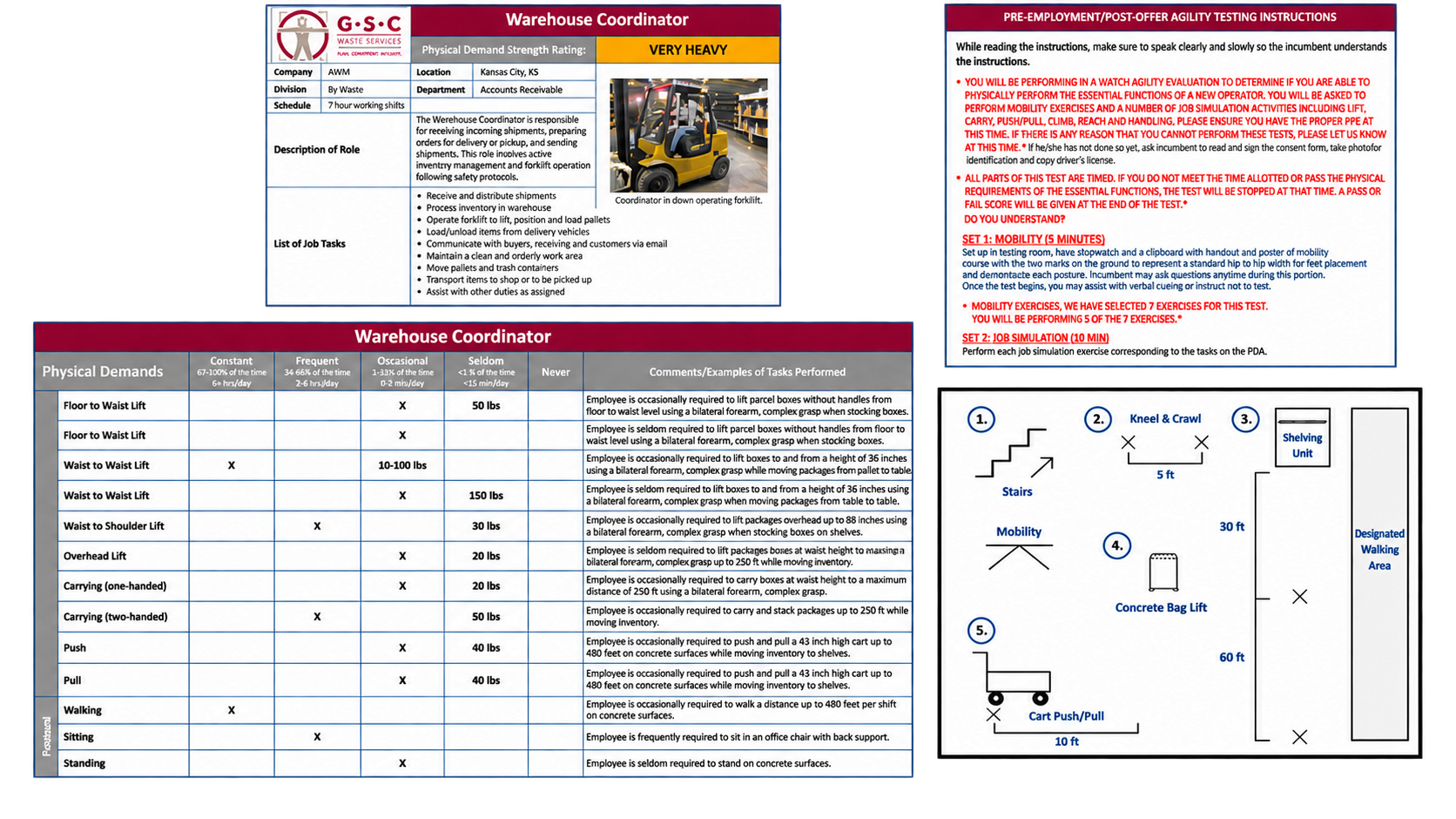
GSC’s Pre-Employment / Post-Offer Agility Testing starts with the Physical Demand Analysis and essential functions of the job. Testing is developed from the actual physical requirements of the position, then validated with employees who perform the work to ensure the test reflects real-world job demands.
The result is a standardized, reproducible, job-specific test with objective pass/fail outcomes. Results can be evaluated against NIOSH research and population findings to provide additional context for physically demanding occupations. The approach supports the ADA/EEOC principle that employment tests be job-related and consistent with business necessity.
THE SAME BASELINE, AFTER THE HIRE
The value of a job-specific test doesn't end when someone is hired. The same documented physical baseline can be used to evaluate fit for duty following a work-related injury, illness, surgery, or disability of leave—comparing an employee's current functional capabilities with the actual requirements of the job.
This is particularly relevant for musculoskeletal conditions, which accounted for 30% of private-sector cases involving days away from work in 2018.
One job. One documented physical standard. A baseline that can support workforce decisions from hiring through return to work.

TESTING YOUR WAY
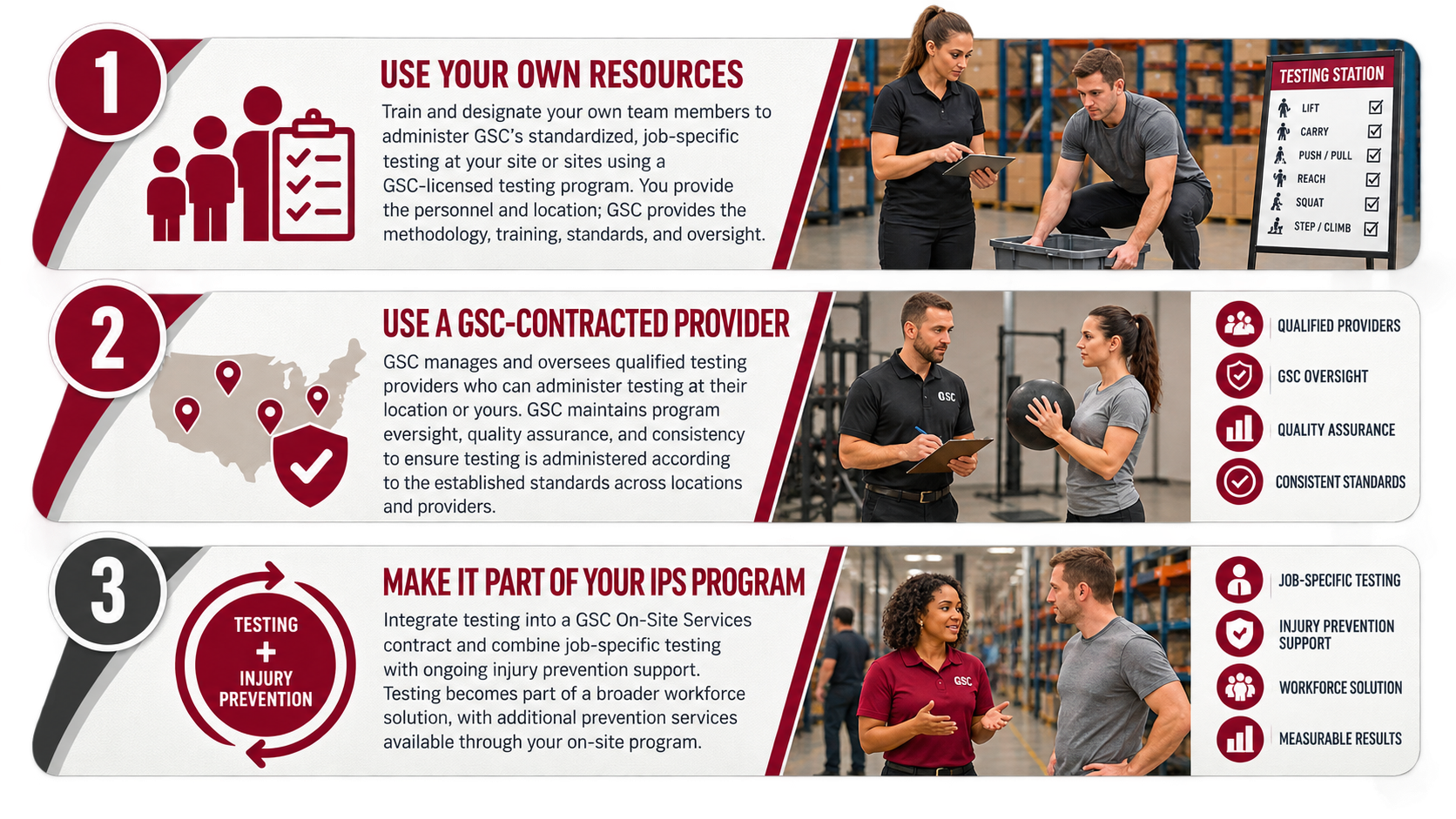
GSC offers flexible testing administration options designed to fit your workforce, locations, and resources.
EVERYTHING YOU NEED TO ADMINISTER WITH CONFIDENCE
GSC provides the documentation, tools, workflows, and training needed to implement and administer a standardized, consistent, job-specific testing program. Whether testing is administered by your team or through a GSC-contracted provider, the program is designed to maintain consistency, quality, and complete documentation from scheduling through final outcome.
-
Complete documentation supporting the job-related testing process, administration, results, and records needed to support ADA/EEOC considerations.
-
Defined procedures, protocols, and administration standards to ensure the test is delivered consistently across employees, locations, and administrators.
-
Required equipment specifications, equipment lists, testing-space requirements, and setup instructions to establish a consistent testing environment.
-
Documented workflows for scheduling candidates, administering tests, recording results, managing outcomes, and maintaining testing records.
-
Practical guidance and supporting documents for incorporating job-specific testing into test policies, job postings, candidate communications, and the hiring workflow, helping HR apply the program consistently and appropriately across positions and locations.
-
Training for customer-designated administrators and GSC-contracted providers, including test protocols, administration procedures, documentation, and quality expectations.
-
For provider-administered programs, GSC provides ongoing oversight and quality management to support consistency across administrators and locations.
Testing Questions, Answered.
-
GSC Agility Testing evaluates an individual’s physical capabilities against the documented physical demands and essential functions of a specific job. The test is built from the job—not from a generic fitness standard.
-
The PDA establishes the actual physical requirements of the job. Using that information creates a job-specific physical baseline so the test measures the capabilities that are actually required to perform the work.
-
Testing criteria are developed from the job’s documented demands and validated with employees who currently perform the job. This helps confirm that the test reflects the actual work and can be administered consistently and reproducibly.
-
GSC’s approach is designed around the principle that employment tests should be job-related and consistent with business necessity. The connection between the essential functions, physical demands, and testing criteria provides the documentation supporting that relationship.
-
A pass/fail outcome indicates whether the individual demonstrated the physical capabilities established as necessary to perform the specific job requirements. Results can be evaluated against relevant NIOSH research and population findings to provide additional context.
-
Yes. The job-specific physical baseline can be used for fit-for-duty and return-to-work evaluations following a work-related injury, illness, surgery, or disability leave. The employee’s current capabilities can be compared with the documented requirements of the job.
-
Organizations can use their own trained and GSC-licensed personnel, a GSC-contracted testing provider, or integrate testing into a GSC On-Site Services program.
-
GSC provides standardized protocols, equipment specifications, administration procedures, documentation, and training. For contracted providers, GSC provides additional oversight and quality assurance to maintain consistency across administrators and locations.
-
Yes. GSC can establish a standardized testing program across multiple sites while providing the training, documentation, workflows, and quality controls needed to maintain consistency.
-
Testing should remain aligned with the work. When job demands or essential functions materially change, GSC can review the PDA and testing criteria to determine whether the test remains appropriate or needs to be updated.
-
When testing is based on the documented essential functions and physical demands of the job, a failed result indicates that the candidate did not demonstrate the physical capabilities established as necessary to perform that work. Under the ADA, a selection test that screens out an individual with a disability must be job-related and consistent with business necessity. If the individual cannot perform the essential functions, with or without reasonable accommodation, the employer is not required to hire them. GSC provides the objective, job-specific foundation; the employer makes the final employment decision.